Kawasaki H2 Engine Parts & Conversion Engineering
Specialist components for the supercharged H2 engine in cars — dry sump systems, oil control, looms and engine management. Developed from real conversion work, not adapted from motorcycle parts.
An Extraordinary Engine, With Conditions
The Kawasaki supercharged H2 is one of the most compelling engines available to a car builder — 998cc, forced induction from the ground up, and a power-to-weight ratio that very little else approaches at the money. It has found its way into lightweight sports cars, kit and component cars, sports racing cars, single-seaters, hillclimb specials and one-off chassis of every description.
It also has requirements that the original motorcycle never had to meet. Oil control under sustained lateral loading, thermal management outside a motorcycle's airflow, and a complete replacement of the factory electrics are not optional extras — they are the difference between an engine that lasts and one that does not. Those three problems are what our H2 components exist to solve.
Before You Buy an Engine
Two things decide whether an H2 conversion works: which engine you actually have, and how it is geared once the chain drive is gone. Both are covered in full.
Specifications & Variant Identification
The family splits into two mechanically different builds, and the ZXT00NE engine number will not tell you which one you are looking at. Compression ratios, how the variants genuinely differ, how to identify an engine correctly, and why the standard lubrication system becomes the limiting factor in a car.
Read the Engine Guide → Gearbox DataGear Ratios & Final Drive Selection
Ratios and primary reduction figures for every variant, with tooth counts, and a plain account of which figures are solid and which are still disputed. The calculation method for road speed in a direct-coupled installation, the primary reduction error that wrecks most attempts at it, and a worked example of choosing a differential.
View the Ratio Data →Measured on a Dynojet 224xLC and DIN corrected — the same pull published both at the wheel and at the crank, because a crank figure on its own tells you very little without the run behind it. Torque is flat from roughly 8,000 rpm and power climbs almost linearly to nearly 14,000 without the flattening that signals a breathing or fuelling limit.
See Both Dyno Plots →Both references are compiled from Kawasaki published data, parts catalogues and our own measurements. Public information on this engine family is inconsistent and in places contradictory; where sources disagree we say so on the page rather than picking one. Use them as the best position we can reach from what is available, and confirm anything you are about to spend money on against the Kawasaki parts catalogue for your specific engine.
H2 Components
Purpose-developed parts for the H2 engine in car installations. Each is explained in detail on its own page.
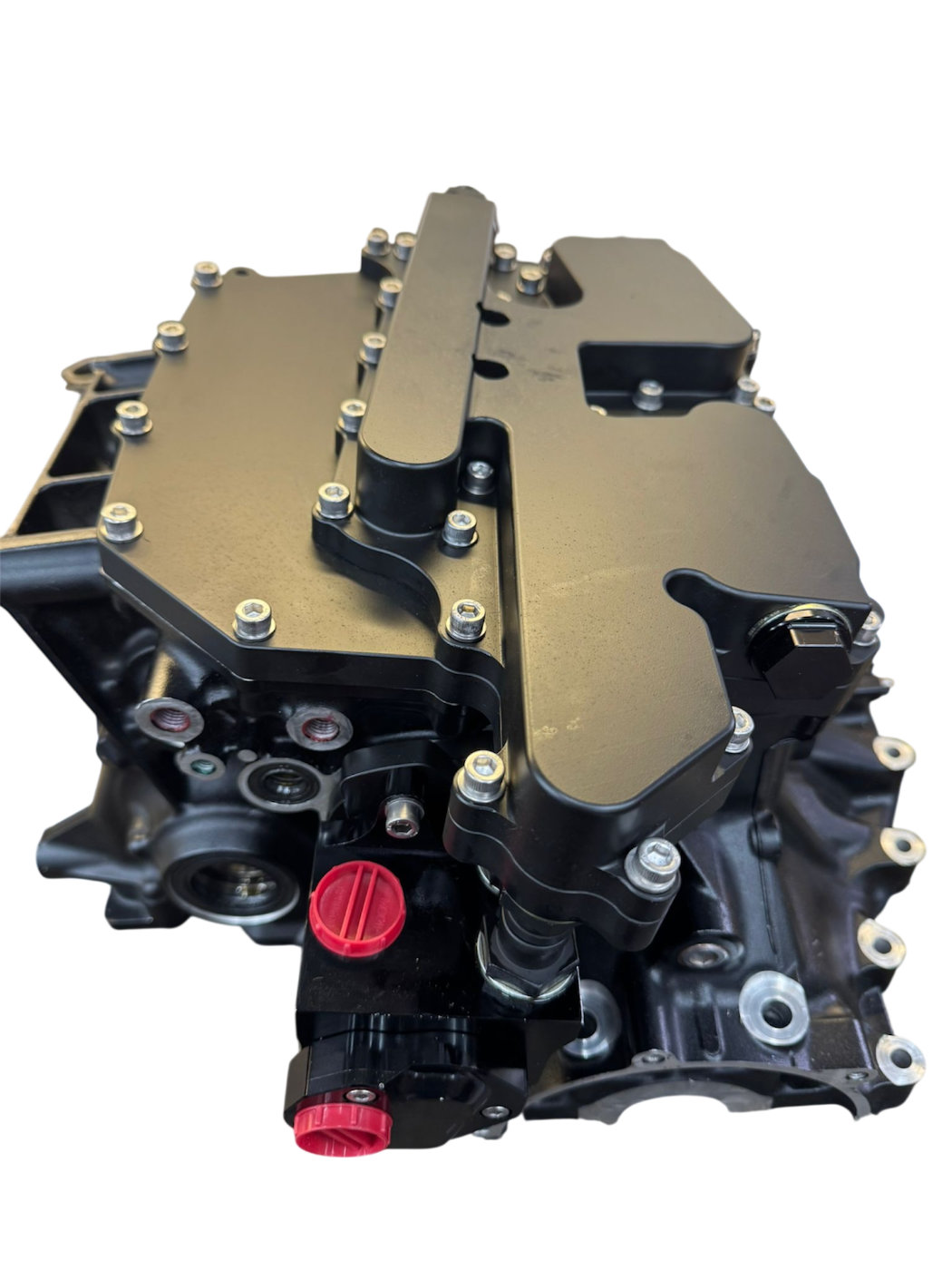
Dry Sump System
Three-stage scavenge dry sump for the H2 engine. Consistent oil supply regardless of cornering load or attitude, reduced windage, and the sump depth taken out of your packaging problem.
OE Oil Cooler Blanking Plate
Fitted in place of the factory oil/water heat exchanger. Oil passes out of the block and straight back in, deleting the OE cooler entirely — for installations running their own remote oil cooling. Four bolts, no plumbing.
Car Conversion Wiring Loom
The factory loom cannot be carried into a car — immobiliser integration, ride-by-wire actuation and motorcycle connector standards all get in the way. A purpose-built engine harness removes that problem at the start of the project, with plug-in launch, paddle shift and wheel speed harnesses available now or later.
Standalone ECU Options
Correctly configured engine management for the H2 in car use — trigger interpretation, throttle actuation, fan and fuel pump control, warning strategy and data logging. Specified around your installation and intended use.
High Volume Oil Pump
A wider EN26 steel gerotor raising oil pressure 30–50% across the rev range. Supplied complete with billet pump body, or as the gear set alone where a dry sump has taken over the water pump position.
PAIR Block Off Plates
Block off plates for the PAIR secondary air injection system on the Ninja H2 and Z H2. Removes redundant motorcycle emissions hardware and simplifies the engine for car installation.
MBE 9A9 ECU & Map
A proven motorsport ECU supplied with our own H2 base map. The hardware is available from several places — the calibration that makes a supercharged H2 run properly in a car is what you are actually buying.
Prices shown are ex VAT. The dry sump system and the oil cooler blanking plate are priced and sold separately, and the first production batch is currently in progress — contact us to reserve a set. Where pricing is still to follow, contact us for current pricing, lead times and advice on which components your installation actually needs — we would rather specify it properly than sell you a part you do not require. Further components are in development and will be added as they are released.
Conversion Engineering Support
Beyond the components themselves, we can support the wider engineering of an H2 installation — cooling strategy, oil system layout and tank positioning, mounting and integration, and calibration decisions appropriate to the engine specification you are working with.
Our involvement in H2 engineering comes directly from encountering and solving these problems in practice rather than from reading about them. If you are early in a project, the most valuable conversation is usually the one before anything is bought.
Discuss Your H2 Project
Tell us about the engine, the car and how you intend to use it. We will tell you honestly what the installation needs — and what it does not.
Start the Conversation