Kawasaki H2 Engine Specifications & Variant Guide
What actually separates the variants of the supercharged H2, how to identify an engine correctly before you buy it, and why lubrication is the problem that decides whether a car installation survives.
Understanding the H2 Platform
What matters before you buy an engine. The full detail is in the downloadable reference at the foot of this page.
Everything below is assembled from Kawasaki published specifications, parts catalogues and owner's manuals, from our own measurements, and from working on these engines in cars. Public data on this family is inconsistent and in places contradictory, and where sources disagree we say so rather than quietly choosing one. Treat this as the best position we can reach from what is publicly available — not as a guarantee. Confirm anything you are about to spend money on against the Kawasaki parts catalogue for the specific model and year of engine in front of you.
One Family, Two Engine Specifications
The H2 range is frequently discussed as though it were a single engine. It is not. The family splits into two genuinely different builds, and the difference is mechanical rather than a matter of calibration.
The Ninja H2 and H2R run low compression with higher boost. The Ninja H2 SX and Z H2 run high compression with more moderate boost, using a different cylinder head, camshafts, crankshaft and pistons, along with a different supercharger and plenum chamber. Kawasaki's own terminology is the clearest way to hold the two apart: the H2 and H2R are the power-supercharged engines, the SX and Z H2 the balanced-supercharged engines.
Compression ratio dictates the boost ceiling, fuel sensitivity and off-boost behaviour. A high-output, high-boost build is better served by the low-compression Ninja H2 specification. Strong mid-range and driveability on pump fuel — usually the better answer in a road or hillclimb car — favours the 11.2:1 engines. Calibration developed on one is not transferable to the other.
The same split runs through the gearbox. The two engine specifications carry different primary reductions and different first and second gear ratios, which is covered in full on our H2 gear ratios and gearbox data page.
Why Lubrication Is the Limiting Factor
The H2 wet sump is well designed for its purpose. A motorcycle leans into a corner, so the oil surface stays broadly perpendicular to the sump and the pickup remains submerged. Sustained lateral loading is simply not a design case.
A car does not lean. The same corner produces sustained lateral acceleration acting across the sump, and oil migrates away from the pickup and stays there for the duration of the corner — precisely when bearing loads are highest. The severity scales with the car: a light chassis on slicks through long corners is the worst case, and that is exactly the sort of car this engine ends up in.
This is a geometry problem rather than a capacity problem. It is not reliably solved by baffling, a deeper pan, or simply running more oil. Oil starvation is the recurring failure pattern in car-installed H2 engines wherever the original wet sump arrangement has been retained or only lightly modified.
Identify the Engine Properly
The ZXT00NE engine number prefix appears across the whole supercharged family — Z H2, Ninja H2 SX and Ninja H2 alike — and serial numbers run sequentially across all of them. It tells you nothing about compression ratio or state of tune, so buying on prefix alone is a real risk.
Model suffixes are no better as a guide. SE and SE+ denote equipment — suspension, brakes, rider aids — every part of which is discarded in a car. There is no SE engine specification and no low-compression SE. A Z H2 SE and a base Z H2 are the same engine; an H2 SX SE and a base H2 SX are the same engine. The only thing the badge usefully tells you is the model family it belongs to, and therefore which compression group to expect.
The frame number is what settles it, decoded against the Kawasaki parts catalogue for that model year. Where an engine has been bought loose with no VIN and no history, the gearbox is the fallback: first gear is 51/16 on a Ninja H2 or H2R and 40/13 on a Z H2 or Ninja H2 SX. Every variant in the family uses a dog-ring gearbox, so that count means dismantling the shaft assemblies on any of them. It is a definitive answer rather than a quick one.
Measured, Not Claimed
Power figures are easy to quote and harder to prove. Both plots below are the same pull, recorded on a Dynojet 224xLC and DIN corrected — not a calculation, and not a manufacturer figure.
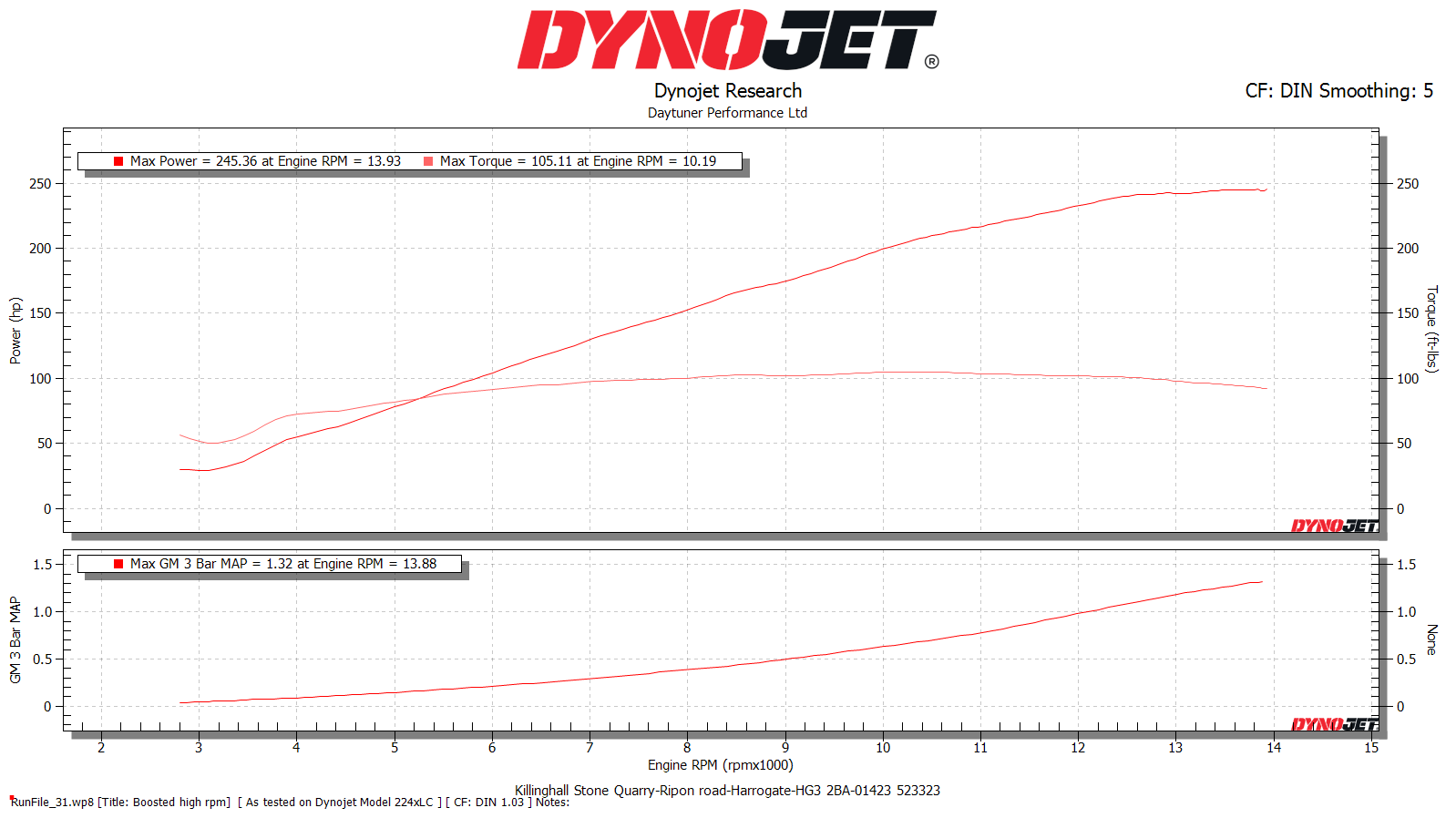
245.36 hp at 13,930 rpm and 105.11 lb-ft at 10,190 rpm, with the boost trace logged alongside it.
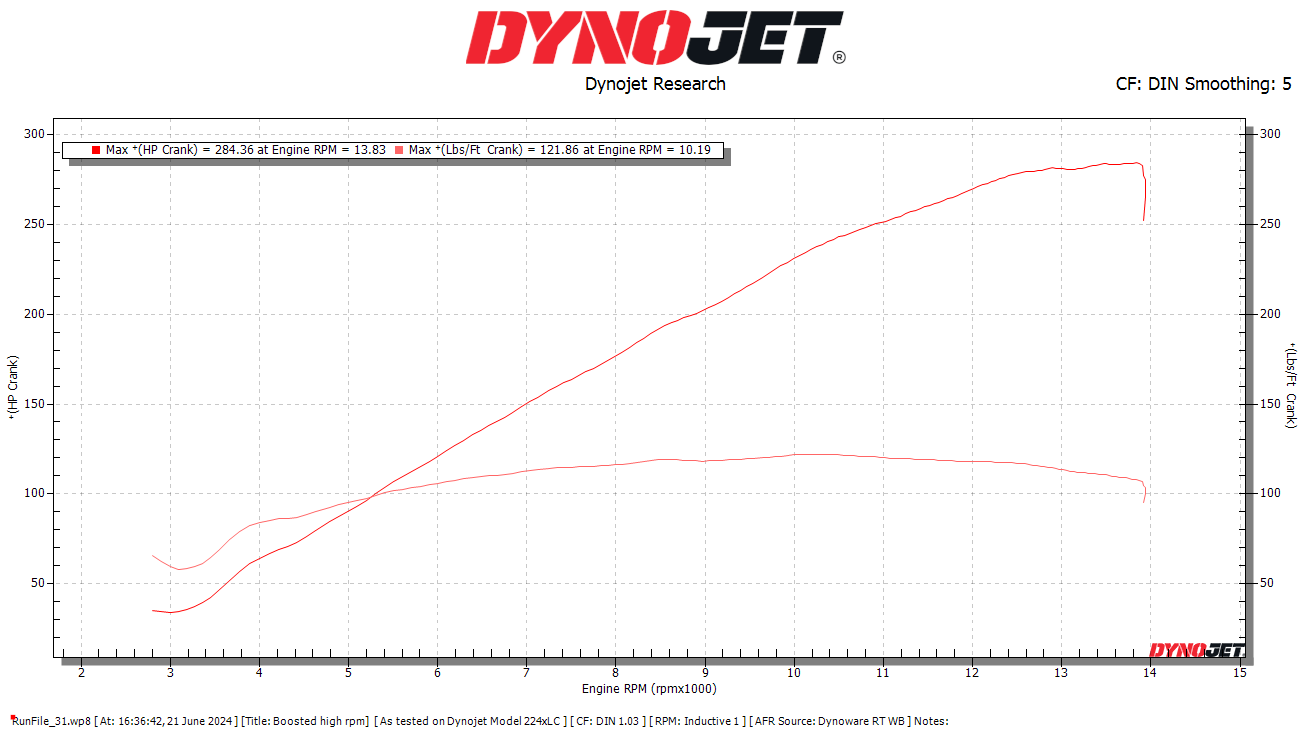
284.36 hp at 13,830 rpm and 121.86 lb-ft at 10,190 rpm — the same run, with driveline loss accounted for.
The difference between the two plots is around 13%, which is a normal driveline loss for this installation — and the reason both are published together. A crank figure quoted on its own tells you very little unless the measured run behind it is shown as well.
The shape matters more than the headline number. Torque arrives early and stays flat from roughly 8,000 rpm through to beyond 11,000, so the engine is tractable well below its peak rather than only usable at the top. Power then climbs almost linearly to nearly 14,000 rpm without the flattening that normally signals a breathing or fuelling limit being reached. That combination — a wide, usable torque plateau beneath a still-rising power curve — is what makes the supercharged H2 genuinely viable in a car rather than simply impressive on paper.
That curve shape also drives the gearing decision. A torque peak at 10,190 rpm sitting beneath power that is still climbing at 13,830 changes where the useful shift points fall, and therefore which final drive suits the car — worked through in detail on the gear ratios page.
Recorded 21 June 2024 at Daytuner Performance, Harrogate. DIN correction 1.03, smoothing 5.
How Much Is Actually Available
What the two engine specifications will give in a car without opening the crankcases, why the factory claims never appear on a dyno, and which engine to buy for which target.
Why Claimed Figures Don't Appear on a Dyno
The H2R's headline 326 PS is a ram-air figure — the crank output with the intake pressure available at very high road speed. On a dyno the machine is stationary, so that contribution is absent, and 326 PS is 321 bhp before anything else is considered. The factory calibration is also deliberately conservative at the top of the rev range, with rich fuelling and cautious ignition timing, which is entirely correct for an engine sold with a warranty.
The practical result, reported consistently by owners and tuners on motorcycle dynos, is that a standard H2R measures 230–240 hp at the rear wheel and a corrected calibration adds 30 hp or so — around 300–310 bhp at the crank on a static test. That is the engine as it is. The gap to the brochure is ram air and correction method, not lost performance.
What the H2R Actually Adds
The Ninja H2 and H2R share bore, stroke, pistons, valves, springs and the supercharger itself. What differs is the intake, the exhaust, the camshafts, the ECU calibration, the head gasket and the clutch. The H2R's higher boost is not a different compressor — it is what the same impeller delivers once the intake and exhaust stop restricting it, combined with a far more aggressive ignition map.
That matters in a car, because a conversion supplies its own intake, its own exhaust and its own ECU. Most of the H2R's advantage over the H2 is therefore already present in a properly built car installation before the camshafts are considered. The H2R camshafts are the one remaining item, and they fit the 8.5:1 engine without further parts — a top-cover job, not a rebuild.
The Cost Argument
The reason this engine makes sense in a car is that a used donor is inexpensive. The moment the crankcases are opened — pistons, rods, crank — the cost converges on any other race engine and the advantage is gone. The useful ceiling is therefore the engine as Kawasaki built it, plus the items that stay outside it: camshafts, charge cooling, intake and exhaust, and a standalone ECU with closed-loop lambda and knock control.
On that basis the measured 284 bhp above, from an unopened 11.2:1 engine, is not a starting point. For a lightweight car it is close to the sensible end point, and it was reached for the price of a crash-damaged motorcycle.
Compression Ratio Under Boost
11.2:1 is an ordinary ratio for a naturally aspirated engine. It is described as high in this family only because, under boost, the static ratio is not the pressure the piston sees. Effective compression scales with absolute intake pressure, and at the same boost the 11.2:1 engine is carrying more peak cylinder pressure than an H2R.
Kawasaki balances this on the 11.2:1 engines with moderate boost, torque-biased camshafts and a conservative calibration, and there is no intercooler on any variant. Knock is decided by cylinder pressure and charge temperature, not the static ratio alone — which is why the same engine is comfortable on 99 RON with charge cooling and a proper ignition strategy, and marginal on lower-octane fuel with a fixed map and no cooling. The reported piston failures on tuned 11.2:1 engines sit almost entirely in the second category.
Which Engine for Which Target
For the 8.5:1 Ninja H2 in a car with a free intake and exhaust, a standalone ECU and the H2R camshafts, the published owner and tuner figures point to roughly 265–275 hp at the wheel — around 300–315 bhp at the crank on our 13% driveline factor. Adding charge cooling and raised supercharger drive gearing takes that towards 290–305 at the wheel, 335–350 at the crank, still without opening the engine. Raising boost is the last step, not the first: camshafts and breathing first, then cooling, then boost.
The 11.2:1 engine reaches 284 bhp without any of that, and its strength is mid-range on pump fuel rather than peak output. Camshafts with charge cooling are a reasonable further step. Raising boost is the one thing it should not be asked to do, because that is the variable it is already carrying the most of.
Z H2, H2 SX and SX SE Are One Engine
As a donor, the Ninja H2 SX and SX SE carry the same 11.2:1 specification as the Z H2 — the same high-compression head, camshafts, crankshaft and piston family, and the same 69mm balanced supercharger. Intake routing, exhaust, electronics and trim differ, and all of it is discarded in a conversion. Any of the three is the same engine once installed, and the SX is the more numerous bike. One qualification: second gear may not be common across the group, which is set out on the gear ratios page.
Whether the H2R camshafts fit the 11.2:1 cylinder head has not been verified — the head casting differs from the 8.5:1 engine, and journals, sprockets and chain timing should be checked on the bench before anything is ordered.
The H2 Engine Family Reference
Our complete technical reference on the supercharged H2 platform — the variants and how they genuinely differ, how to identify an engine correctly, why the standard lubrication system becomes the limiting factor in a car, and what a conversion actually requires.
It also covers supercharger specification, oil pressure characteristics and how to interpret them, rev limits and calibration in car use, and what a standalone loom and ECU must account for.
Download the Reference (PDF)Discuss Your H2 Project
Tell us about the engine, the car and how you intend to use it. We will tell you honestly what the installation needs — and what it does not.
Start the Conversation