Next-Generation Hybrid LSD — UK & Europe
OS Giken Dual Core LSD
Torque-sensitive and rotation-sensitive in a single unit. Japanese precision engineering for the Caterham Seven.
The Next Generation — Beyond the Super Lock
The OS Giken Dual Core LSD shares its foundation with the acclaimed Super Lock — the same LTCS pressure ring design, the same construction quality, the same smooth low-speed behaviour. But it adds something no conventional clutch-type LSD can offer: the ability to lock when a wheel lifts from the road.
This is not a marginal refinement. On a Caterham Seven, where the combination of light weight and significant power can unload a rear wheel under hard acceleration through a corner or over a crest, a standard LSD simply stops working the moment that wheel lifts. The Dual Core does not. Its spiral side gears detect the rotational difference and lock the differential before power is lost to the spinning wheel.
The result is a unit with two distinct locking mechanisms operating in parallel — one torque-sensitive, one rotation-sensitive — hence the name Dual Core. For the right application, it is a fundamentally more capable piece of engineering.
How the Dual Core Works
Two operating states, two locking mechanisms — one seamlessly integrated unit.
Both Wheels Loaded
When both rear wheels are in contact with the road and carrying load normally, the Dual Core operates identically to the OS Giken Super Lock LSD. The LTCS pressure ring system governs locking behaviour — progressive, smooth, and predictable. At low speed and light load, the unit behaves like an open differential. Under power, it locks progressively as torque differential increases.
A driver will not feel any difference between the Dual Core and the Super Lock in this state. The everyday driving character is identical.
Wheel Lift Detected
When a wheel lifts — whether over a crest, through a compression, or under hard acceleration on a cambered road — the rotational speed of that wheel increases suddenly as it loses traction. The spiral-cut side gears detect this rotational difference immediately. The spiral gear geometry pushes against the friction plates, activates the cam mechanism, and locks the differential before the wheel can spin freely.
This is the critical advantage. A conventional clutch-type LSD — including the Super Lock — cannot remain activated when a wheel is in the air. The Dual Core can. Power continues to be delivered to the grounded wheel.
The Defining Difference — Spiral Side Gears
One design change. Two operating principles.
In the OS Giken Super Lock LSD, the side gears are parallel-cut — straight teeth that transmit torque cleanly but respond only to torque differential between the wheels. This is the standard approach in clutch-type LSD design.
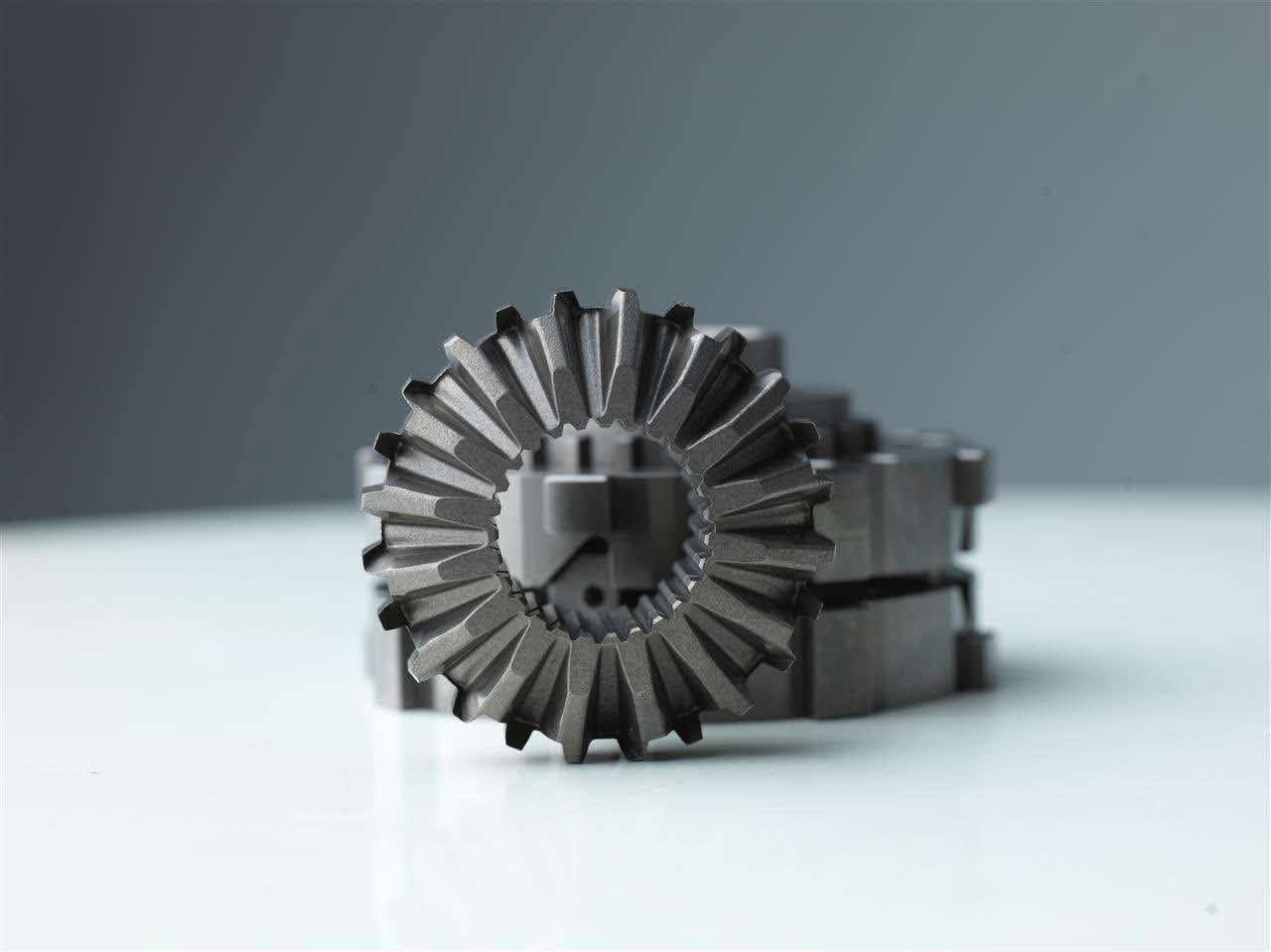
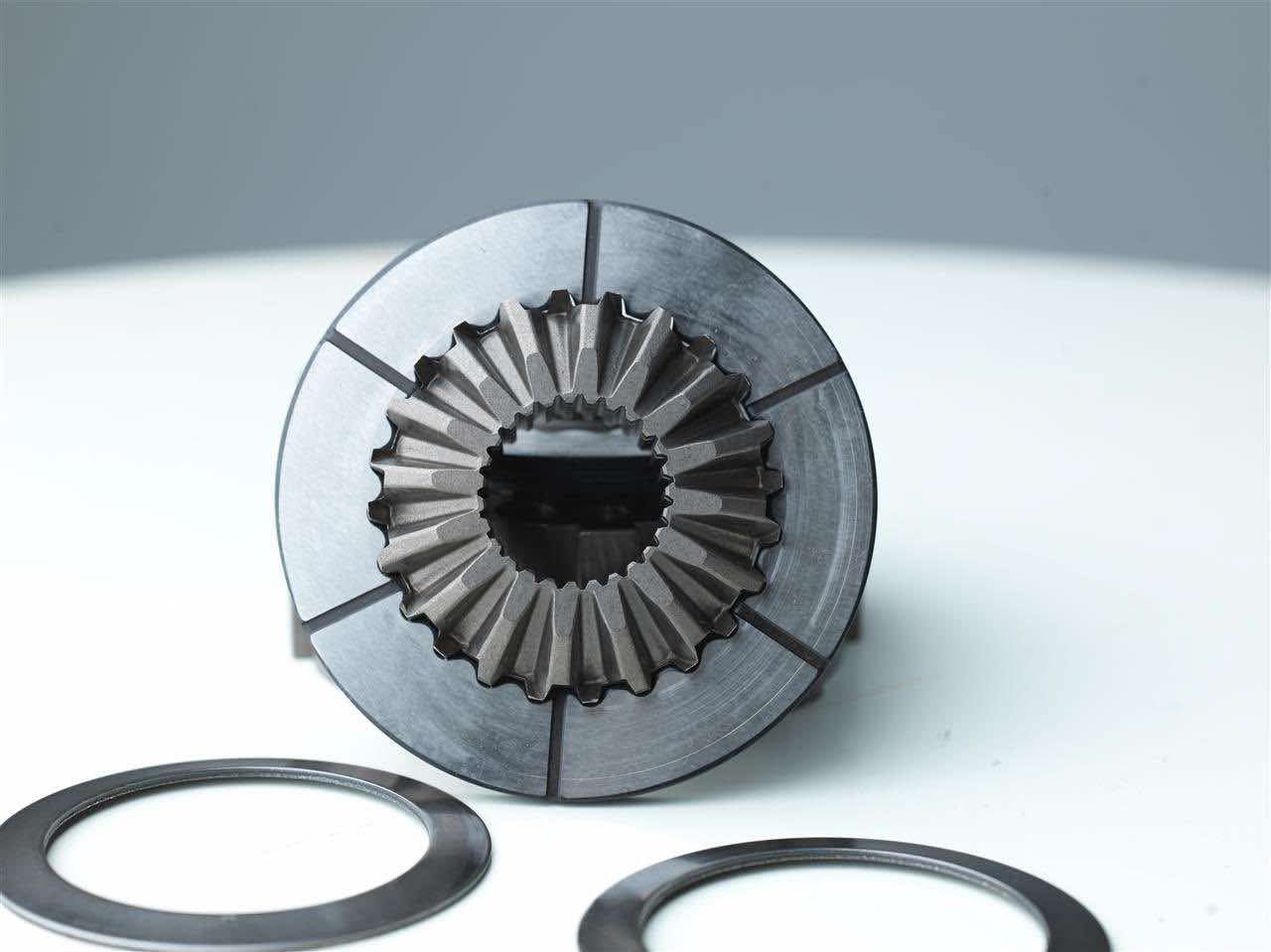
In the Dual Core, the side gears are spiral-shaped — helically cut teeth that respond to both torque differential and rotational speed differential. When one wheel begins to rotate significantly faster than the other — the signature of a wheel in the air — the geometry of the spiral gear itself generates a pushing force against the friction plates.
This is not an electronic system or a separate mechanism. It is a purely mechanical response built into the gear form. It is immediate, reliable, and requires no sensors or intervention.
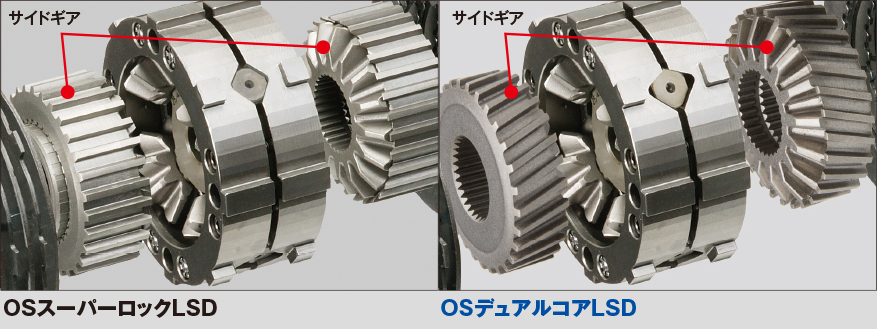
OS Giken Super Lock LSD (left) and Dual Core LSD (right). The spiral-cut side gear of the Dual Core is visible in the gear tooth profile — the defining change that adds rotation-sensitive locking capability.
Which Caterham Drivers Should Specify the Dual Core
Suited to the Dual Core
- Hillclimb competitors where wheel lift over crests is routine
- Circuit drivers on bumpy or undulating tracks where rear wheel loading varies significantly
- High-power Caterham variants where rear traction under acceleration is a persistent challenge
- Drivers running aggressive suspension setups with higher roll stiffness — which can increase the likelihood of wheel lift
- Competition use where every fraction of traction on exit matters
Consider the Super Lock Instead
- Fast road and track day use on smooth circuits where wheel lift is not a realistic scenario
- Drivers prioritising the smoothest possible low-speed and road behaviour
- Lower-power Caterham variants where traction is less of a limiting factor
- Applications where the Super Lock's torque-sensitive locking is already correctly matched to the use case
The Dual Core is not automatically the superior choice. On a smooth circuit with a well-sorted Caterham, the Super Lock will often produce better overall results. The decision depends entirely on your specific application, your circuit, and your car's behaviour. That assessment is precisely what we provide.
Super Lock vs Dual Core — At a Glance
| Feature | Super Lock LSD | Dual Core LSD |
|---|---|---|
| Locking Type | Torque-sensitive | Torque-sensitive + Rotation-sensitive |
| Side Gear Design | Parallel cut | Spiral cut |
| LTCS Pressure Ring | Yes | Yes |
| Low-Speed Behaviour | Open differential feel | Open differential feel |
| Locking Under Wheel Lift | No | Yes |
| Build Quality | Chemically heat treated, billet case | Chemically heat treated, billet case |
| Break-in Required | None | None |
| Ideal Application | Fast road · Track day · Smooth circuits | Hillclimb · Bumpy circuits · High-power competition |
OS Giken Dual Core LSD
Specification at a Glance
| Type | Hybrid Clutch-type Limited-Slip Differential |
| Locking Mechanisms | Torque-sensitive (LTCS) + Rotation-sensitive (spiral side gear) |
| Side Gear Design | Spiral-cut — detects rotational difference between wheels |
| Wheel Lift Response | Locks mechanically when wheel spin detected — no electronics required |
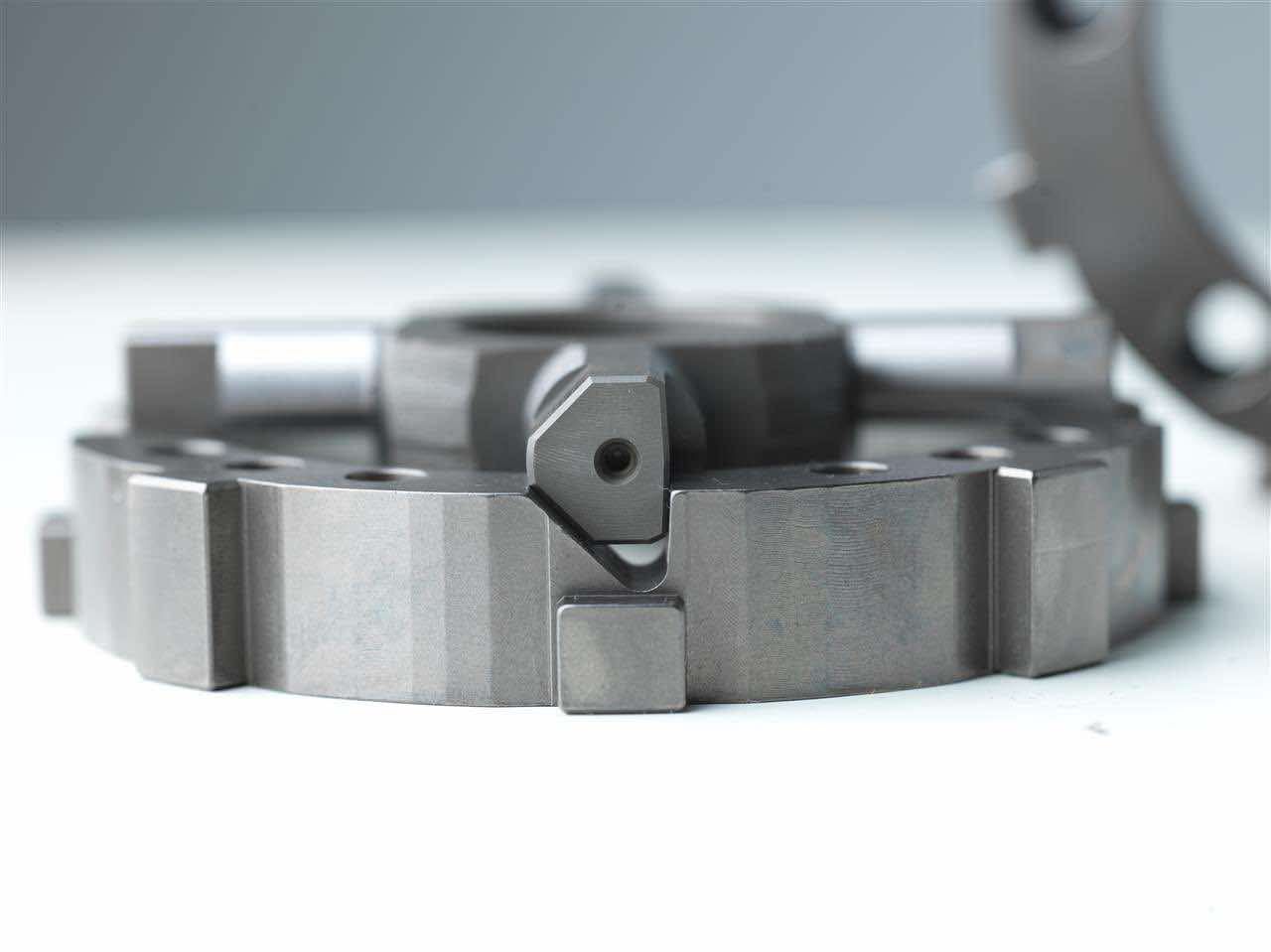
| Case Construction | Single billet machined housing |
| Component Treatment | Chemically heat treated, high-grade steel alloy throughout |
| Break-in Required | None |
| Low-Speed Character | Open differential feel — no clatter, no tight steering |
| Application | Caterham Seven — all variants — particularly hillclimb and competition |
| Supply | UK & Europe — Too Fast To Race |
| Price | £1,671.43 ex VAT · UK shipping £17.50 + VAT |
How We Specify It
The right LSD for the right car.
Choosing between the Super Lock and the Dual Core is not a straightforward upgrade decision. It requires an honest assessment of how and where your car is used, how the suspension is set up, and what the actual limiting factors are on your traction and lap times.
We have the experience to make that assessment correctly — and the integrity to tell you if the Dual Core is not the right choice for your application. Our goal is not to sell the most expensive unit. It is to specify the correct one.
If you run hillclimbs, bumpy circuits, or regularly see the car moving around under power in a way that suggests a wheel is unloading, the Dual Core is worth a serious conversation.
Discuss Your ApplicationApplication Review
We discuss your car, circuits, suspension setup and any existing traction issues before making any recommendation.
LSD Selection
We advise whether the Super Lock or Dual Core is the correct unit for your application — and explain exactly why.
Supply
Your unit is ordered and supplied direct — specified correctly for your differential housing and spline count.
Support
We remain available as your car develops — whether that means revisiting the LSD specification or working on the wider chassis setup.
Enquire About the Dual Core LSD
Tell us about your car, your circuits, and how you use it. We'll advise on whether the Dual Core or Super Lock is the right specification for you.
Get in Touch